Serum Packaging Sizes That Fit Retail vs Clinic Channels
Fifteen, thirty, fifty or a hundred milliliters: serum packaging sizes for retail brands are decided by shelf economics, while clinic packs are decided by cost per treatment, and…
Most brands that brief us on a private label vitamin C serum have already talked to three other suppliers. The quotes come back within 20%, so price rarely decides it. What decides it is whether the serum is still pale yellow at month eighteen, and whether the supplier can tell you why.
This checklist is the nine things our own QC team would ask if we were buying instead of selling. Work through them in order — the first three eliminate most of the market.
L-ascorbic acid oxidises in water. That is chemistry, not a manufacturing defect. Once the molecule meets oxygen, copper, or iron, it converts to dehydroascorbic acid and then to diketogulonic acid, and the color runs from clear to straw to orange to brown.
The practical consequence is that a private label vitamin C serum cannot be judged from a sample bottle alone. A supplier can hand you a flawless 30 ml amber dropper on Monday and ship you a batch that turns in four months. The only defense is knowing what is in the formula and what the filler actually controls.
There are four levers that buy shelf life: chelation, pH, water quality, and headspace. A supplier who can talk about all four is a formulator. A supplier who talks only about the packaging is passing your brief to someone else. We wrote separately about why 15% vitamin C serums turn orange if you want the mechanism in more detail.
| # | Check | What good looks like | Why it matters |
|---|---|---|---|
| 1 | Active form and dose | Named derivative + % on the spec sheet | “Vitamin C serum” alone tells you nothing |
| 2 | Chelation system | EDTA or phytic acid declared | Copper and iron are the real accelerators |
| 3 | Water quality | Purified, conductivity logged per batch | Trace metals come in through the water |
| 4 | Dissolved oxygen | Nitrogen purge or vacuum deaeration | Headspace oxygen drives the first 20% of loss |
| 5 | Fill accuracy | ±1.0% by weight, per-batch record | A 30 ml claim is a legal statement |
| 6 | Stability data | 12 weeks at 40°C/75% RH, plus real-time | Accelerated alone is not enough |
| 7 | Batch traceability | Lot number on every unit | Without it, a recall is unbounded |
| 8 | Documentation | COA, MSDS, INCI, plus Free Sale Certificate | Buyers ask for these before the first PO |
| 9 | MOQ and lead time | Stated plainly, in writing | Vague answers become schedule slips |
Ask for the derivative by name. Our own range covers four: 15% L-ascorbic acid with ferulic acid, 10% sodium ascorbyl phosphate, 20% tetrahexyldecyl ascorbate in an anhydrous base, and 12% magnesium ascorbyl phosphate paired with niacinamide. Each behaves differently. L-ascorbic acid gives the fastest visible brightening and the worst stability. THD is oil-soluble and essentially color-stable. If a supplier cannot name the derivative, they are buying a base and labeling it.
Chelation is not optional. EDTA at 0.05–0.1%, or phytic acid if the brand wants to avoid it, binds the transition metals that catalyse oxidation. Ask what is in the formula and at what percentage. On our vitamin C serum platform this line item costs under a cent per unit and roughly doubles real-time shelf life.
Water quality is where cheap factories hide. Purified water has a conductivity spec, and it should be logged per batch. A plant that buys in bulk water or stores it in unbuffered tanks will show metal carryover that no chelator fully covers.
If your brand wants the ferulic-acid route specifically, the reference formula is 15% L-Ascorbic Acid + Ferulic. It is the version most US and EU brands order first.
Dissolved oxygen is the lever most brands never ask about. A high-shear homogeniser gets the formula uniform, but it also whips air into it. Good fillers either sparge with nitrogen before filling or pull a vacuum during deaeration. Ask for the dissolved-oxygen reading on the batch record. Anything above 1 ppm in a 15% L-ascorbic acid system is a countdown.
Fill accuracy is a legal matter, not a cosmetic one. A product labeled 30 ml must contain 30 ml within the tolerance your market allows. We fill by weight to ±1.0% and log it per head, per batch. If a supplier describes fill as “about 30 ml”, that is a label risk you are carrying, not them.
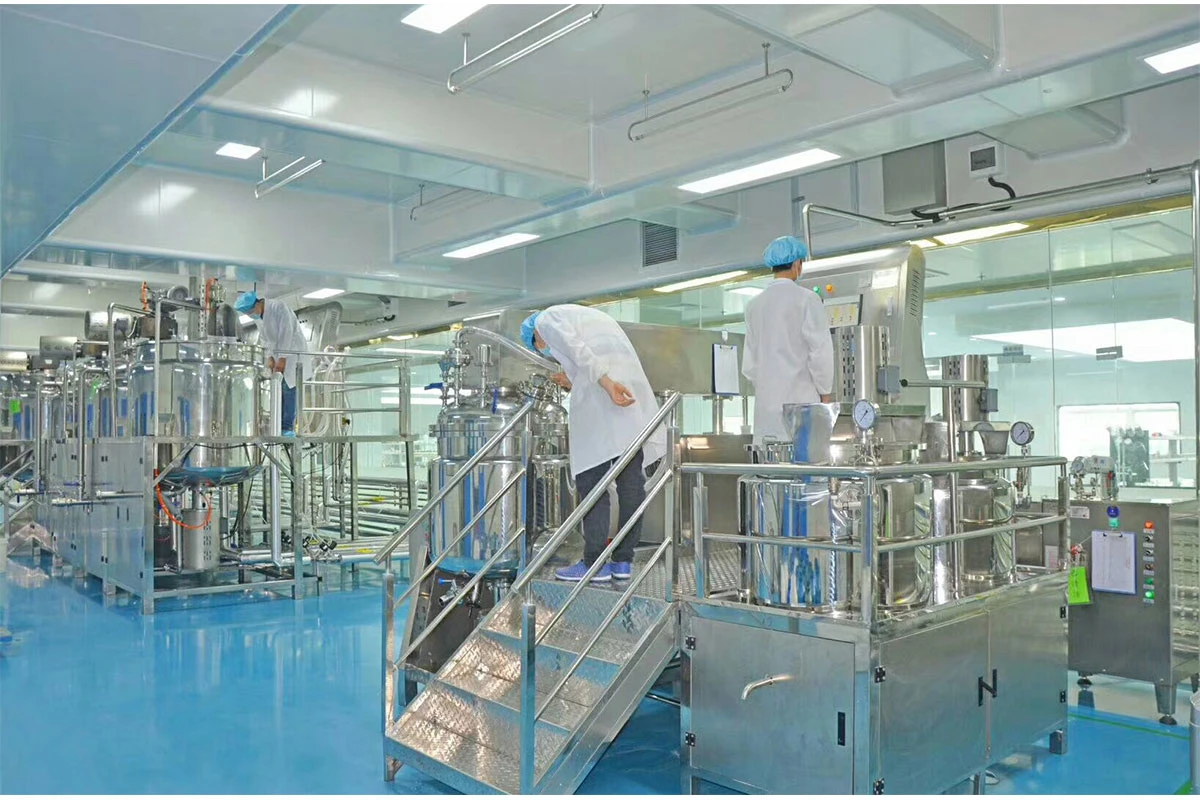
Stability testing has two halves. Accelerated testing — 12 weeks at 40°C and 75% relative humidity — predicts chemical degradation but not packaging interaction. Real-time testing at 25°C runs alongside it and is what you cite on a PAO or shelf-life claim. Any supplier who offers only accelerated data is guessing on the second half. Our quality process and the equipment behind it are documented on the quality and certifications page.
Batch traceability is the one that bites in a recall. Every unit should carry a lot number that maps to a batch record: raw material COAs, water conductivity, fill weights, QC assay. Without it, a single failing batch forces you to recall everything. With it, you recall four lots.
Documentation should arrive before you ask. The standard pack is a Certificate of Analysis, an MSDS, a full INCI list, and a Certificate of Free Sale. Some markets add specific filings on top — the EU wants a CPNP notification, the UK wants SCPN. Confirm which documents the supplier issues themselves and which they subcontract.
MOQ and lead time should be stated in writing, early. Our floor is 1,000 pcs per SKU with a 35-day bulk lead time, and 7 days for a sample. A supplier who says “it depends” without giving you a range is telling you they do not control their own line. If the MOQ conversation is still unclear, our breakdown of how serum MOQ is actually calculated covers where the number comes from.
The single most common error is treating price per unit as the decision variable. A private label vitamin C serum quote that is 18% cheaper often means: no nitrogen purge, reagent-grade water instead of purified, and stability data borrowed from a different formula. That gap shows up as returns in month six, and returns cost more than the 18%.
The second error is ordering packaging before the formula is locked. An airless pump moves the stability profile; a dropper leaves headspace oxygen with the product every time it opens. Choose the packaging after you know the fill and the active — our packaging comparison walks through that sequencing.
Sampling runs 7 days from a locked brief. Bulk production runs 35 days, including QC assay and stability release. Add shipping time for your market.
Yes. That is what OEM means — we produce to your specification, including your active percentages and your preservative system. ODM is the other path, where you start from one of our 24 ready formulas and adjust.
1,000 pcs per SKU. Multi-SKU launches can be scheduled on one line to share tooling and setup time.
Yes. Every private label vitamin C serum we release carries a 12-week accelerated report plus real-time data, and we supply the COA, MSDS and Free Sale Certificate your importer or notified body will request.
—
Send us your brief — target actives, percentages, fill size and market — and we will come back with a formula and a unit price for your private label vitamin C serum within 48 hours, with the stability position stated up front rather than discovered later.
Fifteen, thirty, fifty or a hundred milliliters: serum packaging sizes for retail brands are decided by shelf economics, while clinic packs are decided by cost per treatment, and…
Retinol does not fail in the bottle because the formula was wrong. It fails because the package lets oxygen in twice a day for six months. When a…
Buyers who raise the ISO 22716 vs GMPC certification question usually want a one-line answer about which logo looks better in a quotation pack. The honest answer is…