Almost every brand owner who comes to us with a vitamin C problem describes the same thing: the sample arrived clear, and three months later it is the color of weak tea. The assumption is always that something went wrong in manufacturing. Usually nothing went wrong. L-ascorbic acid oxidises in water — that is the molecule doing what molecules do.
The real question is not whether it will oxidise, but how fast, and what you are willing to trade to slow it down. There are four levers. Each one costs something — money, sensorial quality, or shelf life. Here is how they actually work.
Lever 1: pH — the cheapest and most effective
L-ascorbic acid is most stable below pH 3.5. Above pH 4.0 the oxidation rate climbs steeply, and above 5.0 it accelerates to the point where the serum will visibly darken within weeks. This is why the classic high-strength formulations sit at pH 3.2–3.5 and why they sting a little on compromised skin.
The trade-off is straightforward: lower pH means better stability and better penetration, but more potential for irritation. If your target customer has sensitive skin, you cannot simply push the pH down and hope for the best.
Lever 2: the antioxidant network
Ferulic acid and alpha-tocopherol are not marketing garnish. In the published work behind the well-known 15% L-AA + 1% vitamin E + 0.5% ferulic acid combination, ferulic acid roughly doubled the stability of the ascorbic acid while also providing meaningful photoprotection.
In our own accelerated testing, adding 0.5% ferulic acid to a 15% L-AA serum extended the point at which visible discoloration begins from roughly 8 weeks to roughly 20 weeks under 40 °C / 75% RH. That is the difference between a product that reaches the customer amber-colored and one that arrives clear.
Practical note: ferulic acid is difficult to solubilise and will crystallise out if the solvent system is wrong. If your current supplier’s vitamin C serum has visible particles after a freeze–thaw cycle, this is usually why.
Lever 3: water activity and the solvent system
Oxidation needs water. Reduce the water activity and you slow the reaction. This is why anhydrous and high-glycol systems have become popular: a 20% tetrahexyldecyl ascorbate (THD) serum in a squalane base is essentially inert until it touches skin.
The trade-off is texture. Anhydrous serums feel oily. Some customers love that; others in humid markets find it heavy. Propylene glycol and ethoxydiglycol based systems sit in between — better stability than plain water, lighter than a pure oil.
Lever 4: packaging and headspace
This is the lever most often skipped, and the one that quietly ruins good formulations. Three things matter:
- Oxygen in the headspace. A 30 ml bottle filled to 30 ml has almost no headspace. A 50 ml bottle filled to 30 ml has 20 ml of air sitting on top of your serum for its entire shelf life. Nitrogen flushing before capping reduces this substantially.
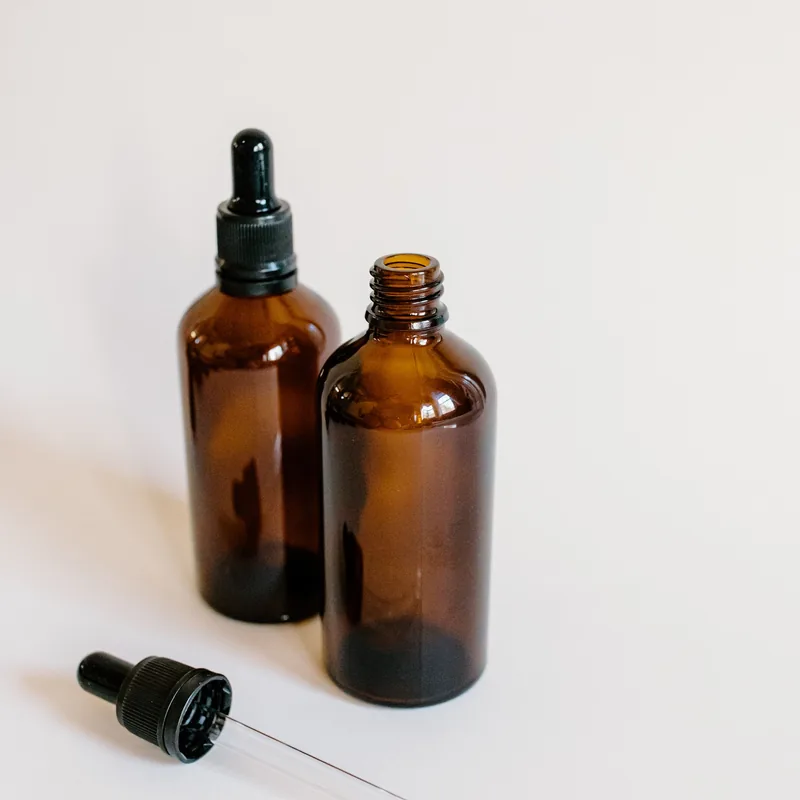
- Light. Amber or opaque glass, or a secondary carton. Clear glass is a display decision, not a stability decision.
- Closure integrity. A dropper with a poor seal lets air exchange with every use. Airless pumps outperform droppers on oxidation, at higher unit cost.
Should you just use a derivative instead?
Often yes. Sodium ascorbyl phosphate, magnesium ascorbyl phosphate and THD ascorbate all convert to ascorbic acid in skin, tolerate neutral pH, and stay colorless for 30 months without special packaging. The honest trade-off: conversion efficiency is incomplete and the clinical evidence base is thinner than for L-ascorbic acid itself.
If your formula must survive a hot climate, an e-commerce supply chain with unpredictable warehousing, and 24 months of shelf life, a derivative usually wins. If you are selling a premium clinical product with controlled distribution, L-AA at pH 3.3 still delivers the best evidence-backed result.
How to brief your OEM
The single most useful thing you can send is your distribution reality, not your formula wish list. Specifically:
- The hottest climate the product will sit in, and for how long.
- Your target shelf life (24 or 30 months changes the preservative strategy).
- Whether you will accept an airless pump instead of a dropper.
- Whether fragrance-free and no-denatured-alcohol are hard requirements.
With those four answers we can usually shortlist two or three formulations from the library and have samples to you inside seven days — instead of spending four weeks developing something that fails accelerated stability in month two.