Airless Pump vs Dropper for Retinol Serum: Compatibility, Oxidation and Cost
Retinol does not fail in the bottle because the formula was wrong. It fails because the package lets oxygen in twice a day for six months. When a…
Fifteen, thirty, fifty or a hundred milliliters: serum packaging sizes for retail brands are decided by shelf economics, while clinic packs are decided by cost per treatment, and the two answers rarely land in the same place. A 30 ml dropper bottle in a printed carton costs us USD 0.36–0.52 in packaging alone at 1,000 pcs; a 100 ml back-bar bottle costs about USD 0.72 but carries three times the fill. The volume you pick also fixes your label area, your overfill, your stability program and your line changeover time. What follows is how the four sizes we actually run at the Guangzhou plant differ, and what each one costs you.
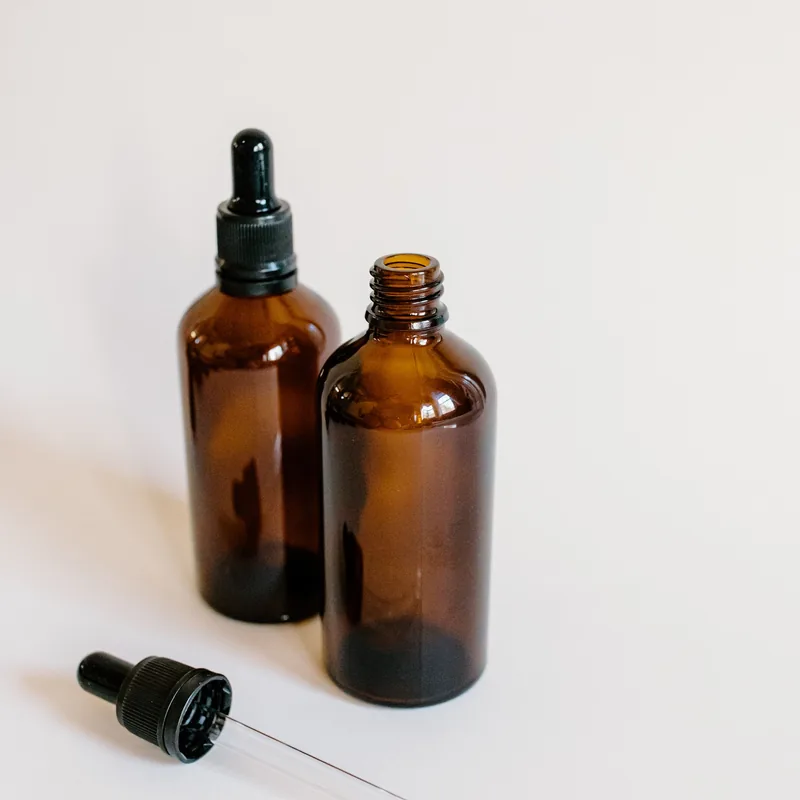
The 30 ml dropper is not a marketing decision. It is the most available mould in Guangzhou: 32.5 mm body diameter, 78 mm height, 18/415 neck, 88–96 g in clear or amber glass, and every closure supplier stocks pipettes for it. Change parts for it exist on every filling line in the province, which is why it also runs fastest at 70–90 bottles per minute.
The dose math is where brands get caught. A full squeeze on a standard 18/415 pipette delivers 0.45–0.55 ml, so a 30 ml bottle is 55–65 applications, not 30. Brands that print “30-day supply” are assuming 1 ml per use, which is double what most users actually dispense. That mismatch produces reviews saying the serum ran out in three weeks — the bottle was fine, the claim was wrong.
Where serum packaging sizes for retail brands actually break is on antioxidants. Fill a 15 ml bottle to 15 ml inside an 18 ml mould and you leave 3 ml of headspace, 20% of the fill; a 30 ml fill in a 34 ml mould leaves about 4 ml, roughly 13%. The oxygen in that headspace is a near-constant quantity, so it consumes a bigger share of a smaller fill. On 15% L-ascorbic acid at pH 3.2 we measured 6–8% more active loss over 12 weeks in 15 ml than in 30 ml of the identical batch.
Retail packs have to carry text, and text needs area. A 30 ml bottle takes a 55 × 45 mm wrap label, about 2,500 mm², against an INCI list of 15–22 ingredients at 4.5–5 pt, plus nominal content, batch code, PAO symbol, responsible-person address and any EU 1223/2009 warnings. It fits, barely, and it stops fitting below about 20 ml.
That single constraint drives half the packaging decisions we see. A 15 ml dropper cannot hold a full EU label, so a folding carton stops being decoration and becomes the primary label carrier — which adds USD 0.11–0.22 per unit at 1,000 pcs and 12 mm of print height for the Braille band the EU requires for product name and nominal content. The facial serum catalog can stay simple; the carton cannot.
Cartons bring their own arithmetic. 34 × 34 × 95 mm is the common 30 ml size, and an EAN-13 needs 37.3 × 25.9 mm including quiet zones, so the barcode goes on the base panel — never on the curved front where the scan angle fails at a shop till.
These are the four formats that serum packaging sizes for retail brands usually resolve to, with packaging cost at 1,000 pcs and the constraint that decides each one. The formulas in our serum formulation library map onto all four.
| Size | Neck / closure | Channel it fits | Packaging cost at 1,000 pcs | Real constraint |
|---|---|---|---|---|
| 15 ml | 18/415 dropper | Trial, travel, clinic retail kit | USD 0.26–0.38 | No room for a full EU label; carton mandatory |
| 30 ml | 18/415 dropper | Core retail, DTC | USD 0.30–0.45 | 55–65 doses; short clock on antioxidants |
| 50 ml | 18/410 or 20/410 airless pump | Retail value size, salon resale | USD 0.85–1.40 | Airless needs ≥1,500 mPa·s or the pump drips |
| 100 ml | 24/410 pump or flip-top | Clinic back bar, refill | USD 0.55–0.90 | Changeover cost; challenge test on multi-dose |
Fifty millilitres is the awkward one. An airless pump at that volume needs a 0.20–0.25 ml stroke, so you get 200–250 doses, which sounds generous until you price it: the pump alone is USD 0.55–0.90 of the total. It only pays back on a formula that oxidizes, such as 0.5% retinol or a 15% ascorbic acid serum, where headspace oxygen drops from 14–17% to 3–5%.
Retail and clinic buyers price the same bottle differently, which is why serum packaging sizes for retail brands cannot simply be copied into a professional range. A clinic back bar is bought on cost per treatment. At 0.25 ml per pump and 100 ml of fill you get roughly 380 treatments; even at USD 0.72 of packaging the pack adds under 0.2 cents to each one. That is why 100 ml and 120 ml PETG pump bottles dominate the professional channel, and why a 30 ml glass retail bottle looks irrational to a salon buyer.
Multi-dose changes the testing. A 100 ml pack that a therapist pumps 30 times a day needs an ISO 11930 challenge test on the finished pack, and the preservative system has to survive it — 1.0% phenoxyethanol with 0.6% ethylhexylglycerin passes in our 30 ml dropper but goes marginal at 100 ml with a pump that lets air back in. Single-dose 2 ml ampoules solve that and cost more: ISO 8 filling, 0.22 µm filtration, and a 1,000 pcs minimum most brands only meet across a full range.
If you are still choosing between closure types, the dropper versus airless pump trade-off is covered in our packaging comparison for serums, including the 8-week in-use residue data.
Per-millilitre packaging cost is where serum packaging sizes for retail brands get decided, and it tells the honest story. At the numbers above, 15 ml costs 1.7–2.5 cents per ml, 30 ml costs 1.0–1.5, 50 ml airless costs 1.7–2.8 and 100 ml costs 0.55–0.90. Down-sizing to hit a price point is the most expensive thing a new brand does, and it usually happens for a reason that has nothing to do with unit economics.
Freight is the second bill. A thousand 30 ml units ship at roughly 130 kg gross in cartons; the same thousand in 100 ml runs about 260 kg, and at USD 6–8 per kg air freight that is USD 0.8–1.6 per unit before the bottle is filled. Sea freight removes most of that but adds 25–35 days, which for a first order is often the difference between launching this quarter and next.
Decoration has hard floors. Pressure-sensitive labels run from 1,000 pcs; silk screen needs 3,000 per color; hot stamping starts at 5,000. At the 1,000 pcs MOQ every SKU we quote, labels are the only decoration that fits — plan the premium finish for the second order, or accept USD 1,800–3,200 of plate cost spread over a thousand units. What 1,000 pcs covers in total, components included, is broken down in our MOQ guide.
Every size change is a physical change. Moving a line from 30 ml to 100 ml means new star wheels, nozzles, grippers and capping heads: 4–6 hours of downtime and USD 600–1,200 in change parts, per size, per line. That is why we quote two sizes as two SKUs, and why a brand wanting 15/30/50 ml across three formulas is really asking for nine runs.
Headspace purge scales with bottle height too. A 30 ml bottle needs about 1.2 seconds of nitrogen to bring headspace oxygen under 5%; a 100 ml bottle needs 2.5 seconds, and the line runs 40–50 bpm instead of 70–90. On a 2% HPR or a 0.3% encapsulated retinol starter the extra purge is not optional — we have seen 4–6% more retinol degradation at 12 weeks when a buyer cut it to save 8 cents a unit.
Stability has to run in the final pack, not a lab jar. PP and PETG walls adsorb 0.8–1.6% of a lipophilic active over 12 weeks, elastomer in a pump absorbs fragrance and some esters, and glass leaches alkali into a pH 3.2 fill. Our 12-week accelerated program at 40°C/75% RH runs in the exact bottle, closure and carton you will ship, with HPLC assay at 0, 4, 8 and 12 weeks, inside an ISO 22716 certified plant. A formula approved in a glass beaker is not approved.
Usually yes, on preservative. The actives stay the same, but a multi-dose pump pack needs a challenge test a 30 ml dropper never faces, and the preservative level often moves up 0.1–0.2%. Budget one extra stability run.
You can, but each size is a separate SKU at 1,000 pcs and a separate changeover. Three sizes across two formulas is six runs and roughly 12 weeks of plant time. Most brands launch one size, prove sell-through, then add the second.
Directly. Headspace ratio, closure permeation and label area all change with size, so a 24-month claim proven in 30 ml does not automatically transfer to 15 ml. Test the pack you ship, or claim the shorter number.
—
Send us your brief with your target channel and fill volume, and we will come back within 48 hours with a pack recommendation, a unit price and the stability program it needs — 1,000 pcs per SKU, 7-day samples, 35-day bulk lead time.
Retinol does not fail in the bottle because the formula was wrong. It fails because the package lets oxygen in twice a day for six months. When a…
Buyers who raise the ISO 22716 vs GMPC certification question usually want a one-line answer about which logo looks better in a quotation pack. The honest answer is…
Halal and vegan serum certification is two audits sold as one project, and the paperwork is the smaller half. One asks where every gram of raw material came…