Serum Packaging Sizes That Fit Retail vs Clinic Channels
Fifteen, thirty, fifty or a hundred milliliters: serum packaging sizes for retail brands are decided by shelf economics, while clinic packs are decided by cost per treatment, and…
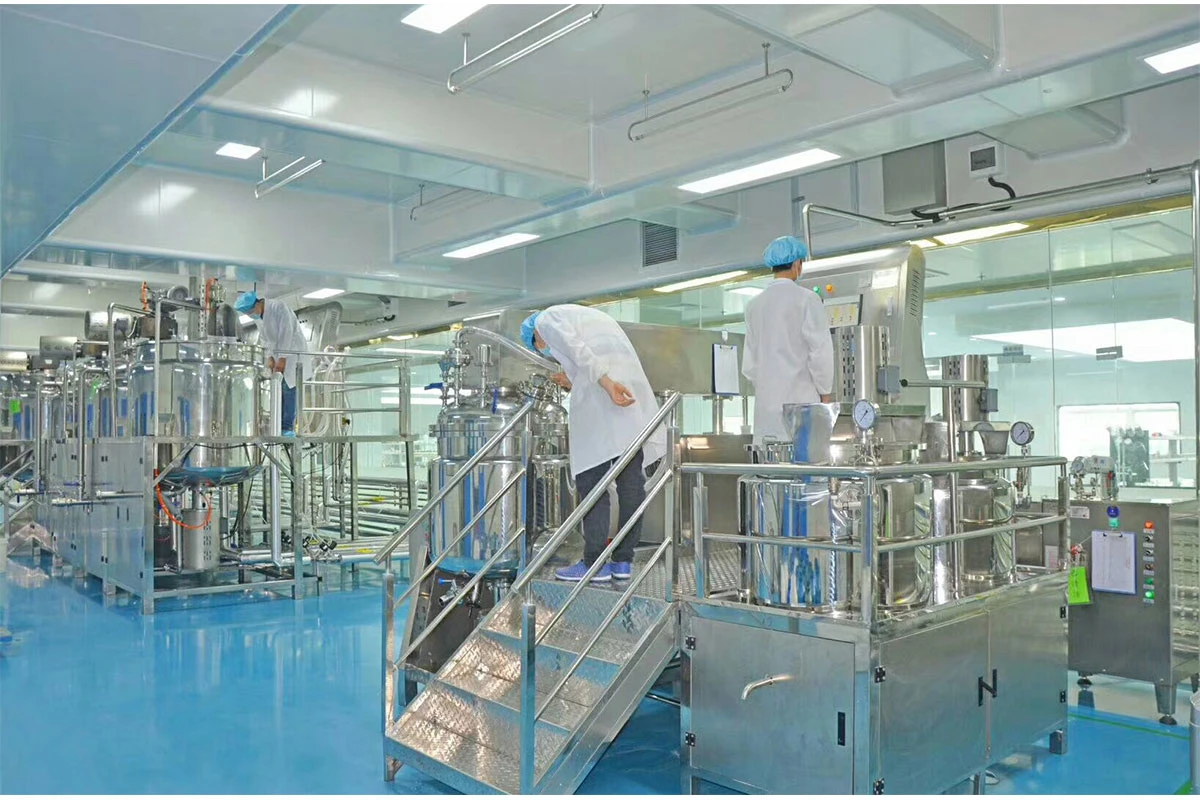
A serum filling line, not the formula, is where most of your unit cost is decided. A 500 kg batch of a 30 ml product is about 16,600 units on paper — run it on a line that loses 2% at the start and end of the run and you have just paid for 330 units nobody will ever sell. The active choice moves one cost line; the line moves the yield of every cost line at once. What follows is the walk-through we give brands before a fill spec is approved, using the numbers our own plant runs on.
Three numbers come off the line and go straight into your price: yield, fill accuracy and changeover time. Everything else — the pump, the nozzle diameter, the number of heads — exists to move those three.
Take a 500 kg batch of a 30 ml serum at a density of about 1.00 g/ml. Gross output is roughly 16,600 units. A clean run on airless returns 98-99% of that; a dropper run on the same batch returns 96-98%, because more product stays in the transfer line and the nozzles drip. That gap is worth 330-660 units per batch, and at a USD 3-5 ex-works unit price it is real money.
Changeover is the second lever, and it is the reason a 1,000 pcs / SKU minimum exists. A full changeover — flushing the hopper, the transfer lines and the filler heads, swapping the piston set, cleaning down, then re-qualifying fill weight — takes 4 to 6 hours on our line. Run two 500-unit SKUs on one day and you have spent a shift on cleaning, which is why small split orders cost more per unit than the formula justifies. The OEM and ODM service page sets out how we group SKUs on the calendar to avoid exactly that.
Most filling faults are built upstream. If the emulsion goes into the holding tank with entrained air, no filler on the market will give you a stable fill weight, because the pump is dosing a mixture of liquid and bubbles.
The sequence we run: water phase to 70-75°C, oil phase to 65-70°C, combine under vacuum of roughly -0.4 to -0.6 bar with a high-shear homogenizer at 3,000-4,000 rpm for 3-5 minutes, then sweep agitation down to 40°C. The vacuum step is not optional on a serum filling line — it is what pulls the air out before the product reaches the nozzles.
Viscosity has to land inside the filler’s window. Our airless heads handle up to about 8,000 mPa·s at 25°C; dropper nozzles start to string and drip above 3,000 mPa·s. So the same base recipe, thickened by 400 mPa·s to carry a higher polymer load, can force you onto a different filling format and a different container. A build like the 0.5% HA and beta-glucan soother sits around 2,500 mPa·s and runs on either format; that flexibility is a deliberate part of how it is designed.
Heat-sensitive actives go in below 40°C on low shear only — encapsulated retinol, L-ascorbic acid and most peptides. Adjust pH at 40°C, not after cooling, because correcting pH at ambient means a second mixing cycle and another 3 hours of tank time. Every batch is assayed by HPLC at release, and the plant and its filling rooms are laid out so the lab bench is 15 metres from the filler.
The format decides more than the look of the shelf. It decides how much product you lose per run, how fast the serum filling line can move, and how tightly you can hold net content for your market’s labeling rules.
| Format | Fill accuracy | Line speed | Loss at start and end | Viscosity ceiling | Container cost per unit |
|---|---|---|---|---|---|
| Airless pump, 30 ml | ±1% by weight | 1,800-2,400 pcs/hour | 1.0-1.5 kg per SKU | ~8,000 mPa·s | +USD 0.18-0.35 |
| Dropper bottle, 30 ml | ±2-3% by weight | 2,500-3,000 pcs/hour | 1.5-2.5 kg per SKU | ~3,000 mPa·s | +USD 0.06-0.10 |
| Ampoule, 2 ml | ±0.5% (pre-dosed) | 6,000-9,000 pcs/hour | 2-3 kg per SKU | under 500 mPa·s | +USD 0.12-0.20 plus breakage |
Airless is not a premium choice, it is an oxygen decision. A retinol or L-ascorbic product oxidises against headspace air, and the pistons limit you to the fill weights the tooling was made for — usually 15 ml and 30 ml. Droppers are cheaper, faster and far more forgiving on viscosity, but every open-close cycle exchanges air with the bottle. Ampoules give the tightest fill weight and the longest shelf life, at the cost of a glass line, breakage in transit and a consumer ritual many buyers reject. Our breakdown of dropper versus airless covers the compatibility side of that choice in more detail.
Budgets are usually built from the formula cost per kilogram and the container price. Those are the two numbers that matter least on the line.
Start and end loss. A 500 kg batch leaves 1.5-3 kg behind in the hopper walls, the transfer line and the filter housing. That is 0.3-0.6% on a production batch — and roughly 3% on a 100 kg pilot, which is why pilot unit costs look alarming and should never be quoted to retail partners.
Fill weight giveaway. Net content rules mean you must meet the labeled 30 ml, so the filler is set to a target above it, typically 30.4-30.6 g. At 30.6 g you are giving away 2% of the batch on every bottle, every run, forever. On 500 kg that is 10 kg of finished product per batch, and it is the single easiest 2% to argue about with your manufacturer.
Rework and scrap. If viscosity drifts 15% mid-run — usually because the holding tank is not on sweep agitation, or the room is warm — an airless head that was holding ±1% can start running ±3%. We check 10 consecutive units every 30 minutes against a ±1% tolerance, because a worn piston gasket can pass 200 bottles before anyone notices. Reworked product is not the same product, and most markets will not let you call it the same batch.
If your first launch is 3 SKUs at 1,000 pcs each, do not ask for dedicated tooling. Custom airless moulds run USD 6,000-15,000 and 25-40 days, and they do not pay back below roughly 15,000 units per SKU. Run from an existing formula library we already produce and take the shared line.
What you give up is flexibility. On a shared line you choose from the pistons and nozzle sets already qualified, which usually means 15 ml and 30 ml airless or a 30 ml dropper, and your production window is scheduled around other brands’ campaigns. If your product genuinely needs 11,000 mPa·s, a two-phase chassis or a 50 ml fill, a standard serum filling line is not going to bend for it — that is a tooling project, budgeted as one.
There is a second case for walking away: if your differentiator is the container, not the formula — a stone cap, a wooden collar, a custom-moulded glass shape — the filling line is the cheap part and the packaging project is the expensive one. Price that before you price the serum.
Scale-up is three steps: a 3-5 kg lab batch, a 30 kg pilot, then the 500 kg production run. Fill weight is validated on the pilot with 10-unit checks at the start, middle and end, because the pilot uses the same filler head as production — a pilot run on a bench pipette proves nothing about the line.
Stability follows the container, not the formula. We fill the actual airless pump or dropper bottle and hold 12 weeks at 40°C and 75% relative humidity, plus real-time data at 25°C. Testing in a glass jar and shipping in an airless pump is the most common shortcut we are asked for, and it is the one that produces color complaints in month five.
Every batch leaves with a COA, an MSDS, the full INCI list and a Certificate of Free Sale, produced under ISO 22716 and GMPC, with filling in an ISO 8 cleanroom. For EU placement the importer files CPNP; documents come from us, the notification is theirs. The certification documents we issue with every batch are the same set whether you order 1,000 pcs or 100,000.
Sampling is 7 days, bulk is 35 days from approved brief, and the minimum is 1,000 pcs per SKU. For a retinol launch, our retinol serum line is already built for the packaging you will end up needing.
Plan for 1.5-3 kg per SKU on a production batch, and accept that a 100 kg pilot will lose around 3%. The loss is fixed, so it is a percentage problem on small batches and a rounding error on large ones.
Yes, if they use the same chassis and the same container. Different pump formats or a different fill weight means a 4-6 hour changeover, which is what pushes unit cost up on split orders rather than the ingredient cost.
It can halve it. The same formula in an airless pump and in a clear dropper bottle will not age at the same rate, because the dropper exchanges 90-120 air volumes over a three-month consumer period. Test in the container you intend to ship in.
Usually entrained air in the bulk, a holding tank without sweep agitation, or a piston gasket near the end of its life. All three are fixable, and none of them are the filler’s fault in the way suppliers usually mean it.
—
Send us your brief with your target market, container and fill weight, and we will come back with a fill spec, a unit price and a production slot within 48 hours. Samples are 7 days, bulk is 35 days, and the minimum is 1,000 pcs per SKU.
Fifteen, thirty, fifty or a hundred milliliters: serum packaging sizes for retail brands are decided by shelf economics, while clinic packs are decided by cost per treatment, and…
Retinol does not fail in the bottle because the formula was wrong. It fails because the package lets oxygen in twice a day for six months. When a…
Buyers who raise the ISO 22716 vs GMPC certification question usually want a one-line answer about which logo looks better in a quotation pack. The honest answer is…