Private Label Retinol Serum: How to Pick a Manufacturer Without Getting Burned
Most retinol programs do not fail in the marketing deck. They fail at the point where the active goes into the kettle, and nobody catches it for eight…
A custom serum formulation service is not a document you receive at the end. It is roughly forty locked decisions, and your brief names three of them. You write “brightening serum, 30 ml dropper, gentle pH”; the factory still has to fix the active level, the solvent system, the preservative, the viscosity band, the fill temperature and the packaging compatibility before anything goes into a tank. Each of those decisions moves either the unit price or the shelf life, and most of them move both. This is what those decisions look like from the side that signs the batch record.
Three buyers can send the same one-line brief and mean three different projects, and the gap between them is measured in weeks.
Benchmark matching. You courier a competitor’s bottle and ask for the same skin feel. This is the most common request and the least honest one, because the sample in your hand is fourteen months old. Its pH has drifted 0.3–0.5, the fragrance fraction has oxidized, and its viscosity has dropped 10–15% since the day it was filled. We reverse-engineer the INCI order and the texture, not the aging.
Stock adaptation. You start from one of the 24 formulas already on the shelf, say the 15% L-ascorbic acid plus ferulic base, and change two variables: active level and scent. If vitamin C is the base you are adapting, the vitamin C serum platform lists the four concentrations we run and the packaging each one tolerates. Bench sample in 7 days, one revision round, no development fee.
From scratch. New active combination, new texture target, new claim set. Three to four bench rounds, 4–6 weeks, and a development fee usually quoted between USD 1,500 and 4,000, credited back on orders above 5,000 pcs.
The expensive mistake is writing a benchmark-matching brief when you actually want stock adaptation. We will spend two weeks chasing a texture that already exists in a formula from our library you could have had in seven days.
Most formulation disputes are not chemistry problems. They are one of five parameters being pushed outside its working window by a marketing requirement.
| Parameter | Working window | What breaks outside it | Who pays |
|---|---|---|---|
| Active level and solubility | 15% L-ascorbic acid in a glycol/water base; 20% THD only in anhydrous | Above solubility the active recrystallizes in 3–6 weeks: grit on the skin, failed assay | You, as batch rework |
| pH | 3.2–3.6 for L-ascorbic acid; 5.0–5.5 for niacinamide; 4.5–6.0 for tranexamic acid | Niacinamide above pH 6 hydrolyses to nicotinic acid and flushes the face; L-ascorbic acid above pH 4 barely penetrates | 3 weeks of reformulation |
| Viscosity | 1,800–2,600 mPa·s for a dropper (Brookfield T-D, 20 rpm); 3,000+ for airless | Thin serum empties out of a dropper in 4 seconds; thick serum will not prime an airless pump | New packaging or a gellant |
| Preservative | Phenoxyethanol 0.8–1.0% with ethylhexylglycerin, effective below pH 6 | Benzoate and sorbate collapse above pH 5.5; the ISO 11930 challenge test fails at week 4 | Batch scrapped |
| Sensory load | Glycerin above 8% reads tacky; 1–2% silicone is what most buyers are actually feeling | A “clean” brief strips the silicone, tackiness returns, you reformulate twice | Time, then money |
A custom serum formulation service that cannot tell you which of those five it is changing is not formulating. It is copying a template and renaming the file. Ask the specific question in the first call: “which parameter are you moving to hit my texture, and what does it cost me in stability?”
The fifth row is where clean-positioned brands lose the most calendar time. Removing cyclopentasiloxane from a 30 ml dropper serum is chemically simple and sensorially expensive: you gain a cleaner INCI deck and lose the dry-down that made the product feel like it absorbed. The usual patch is 2–3% of a lighter emollient plus 0.2% xanthan gum for body, which buys back maybe 70% of the original feel and adds roughly USD 0.03–0.05 per unit at 30 ml.
Sampling is 7 days and bulk is 35 days. Every custom serum formulation service quotes both numbers cheerfully, and neither of them includes the stage that actually slips.
| Stage | Working days | What it actually depends on |
|---|---|---|
| Brief to bench formula | 3–5 | Completeness of your brief: target pH, active %, fill size, packaging |
| Bench sample delivered | 7 | Courier schedule, not chemistry |
| Your own trial period | 10–14 | You, realistically, with three colleagues testing |
| Revision round, if needed | 5–7 | One variable changed at a time |
| Stability start, 4 weeks at 40 °C | 28 | Cannot be compressed by paying more |
| Artwork and dieline approval | 5–10 | Your designer and your printer’s proof cycle |
| Bulk manufacture and filling | 35 | Tank slot plus component arrival |
The 35 days starts when components arrive, not when you approve the formula. A 30 ml airless pump in a custom color runs a 25–30 day mould and spray cycle; the serum is ready before the bottle is. That single mismatch is why most first orders land at 60–70 days door to door while everyone in the email thread insists the lead time is 35.
If you want the fastest honest path, approve packaging before you approve the formula. Artwork on a stock bottle takes 5 days; artwork on a new mould takes as long as the mould.
Ask for the specification sheet before you ask for the price. A usable one carries seven numbers: pH with the meter model and test temperature, viscosity with spindle and rpm, active assay by HPLC with its tolerance band, preservative level, microbiological limits to ISO 17516, heavy metals (Pb ≤10, As ≤3, Hg ≤1, Cd ≤3 ppm), and fill weight tolerance at ±2% gravimetric. If the sheet says “pH: neutral” or “viscosity: suitable”, you are buying a description, not a specification.
The second document a custom serum formulation service owes you is the INCI list in descending order, because that is what goes on the carton and into the CPNP notification. The third is the COA per batch, with the actual measured value next to the limit, not just a tick. The QC lab and certification scope is worth reading before you sign, since it tells you which of those tests are run in house and which are subcontracted.
What you will not get is the exact percentage of every ingredient. That is the ODM’s IP, and no plant with a real formula library hands it over before a purchase order. The workable middle ground has three parts: a spec sheet with ranges (2.0–3.0% active, not 2.4%), an escrow copy of the master formula held by a third party, and a clause allowing a second plant to reproduce your product if supply stops. Negotiate all three while the NDA is being drafted, not after the deposit clears — at that point your leverage is gone.
Four situations where custom is the wrong purchase:
The tradeoff that never appears in the pitch deck: custom raises your fixed cost per SKU and lowers your flexibility. Three custom SKUs at 1,000 pcs each is a 3,000-unit commitment before a single unit sells, plus three sets of artwork, three stability files and three deviations to manage.
A custom serum formulation service is judged on batch three, not batch one. Batch one is hand-checked by the formulator who designed it; batch three is made by a shift supervisor at two in the morning. What keeps them identical is boring process:
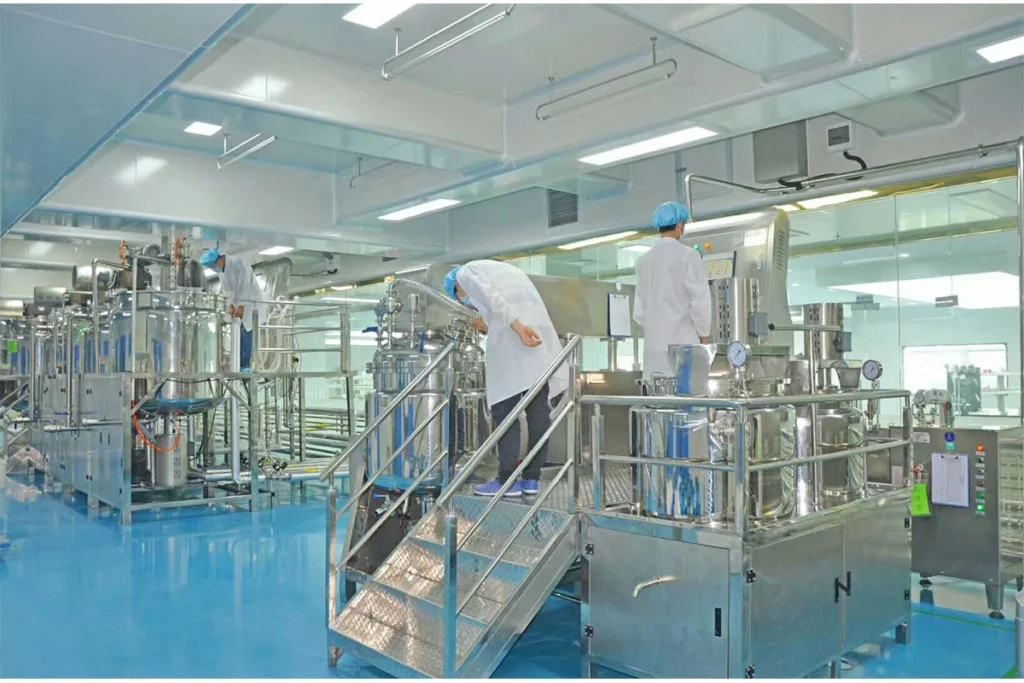
Our smallest jacketed tank is 50 L. A 1,000 pcs order of a 30 ml serum is 30 L of fill plus about 15% processing loss, so it runs one 40 kg batch in the emulsifying and filling hall at roughly 60% tank utilization. That is the arithmetic behind 1,000 pcs per SKU, not a marketing number. If you want a 5,000 pcs first order, the same tank runs four batches and you should ask how the fourth is matched to the first — that question separates a plant from a trading company. The OEM and ODM scope explains which parts of this we do under your formula and which under ours, and the 0.3% encapsulated retinol starter is a useful reference point for how narrow the fill-temperature window gets once an active is encapsulated.
Seven days to a bench sample if you adapt a stock base, 4–6 weeks if the formula is new. Bulk is 35 days from component arrival. Stability runs in parallel and does not delay the first shipment, but the safety report and the CPNP notification have to be filed before the product is placed on the EU market.
On a development-fee project, yes: you get the specification sheet, the INCI list and a formula escrow. On a stock adaptation, no — you license the base and it stays in the library for other clients. Exclusivity is a separate clause, normally tied to 5,000–10,000 pcs per year.
1,000 pcs per SKU. One shade, one carton, one fill size, one batch record. A second fill size is a second SKU and a second stability file, even when the liquid inside is identical.
—
Send us your brief with the target pH, active level, fill size and packaging, and we will come back with a bench formula, a unit price and a 35-day schedule within 48 hours, using this form. 1,000 pcs per SKU, samples in 7 days.
Most retinol programs do not fail in the marketing deck. They fail at the point where the active goes into the kettle, and nobody catches it for eight…
The first question most buyers ask is how to tell a real private label vitamin C serum manufacturer in China from a trading company with a rented office…
A clean beauty serum formulation guide is only worth reading if it prices the removals. Taking a 30 ml brightening serum to a defensible silicone-free, PEG-free, phenoxyethanol-free position…