Sourcing Private Label Vitamin C Serum From a Chinese Factory
The first question most buyers ask is how to tell a real private label vitamin C serum manufacturer in China from a trading company with a rented office…
Most retinol programs do not fail in the marketing deck. They fail at the point where the active goes into the kettle, and nobody catches it for eight months. A private label retinol serum manufacturer that cannot tell you the addition temperature, the nitrogen purge time and the 12-week HPLC curve is asking you to buy a claim you have no way to defend. Below is the diligence I would run if I were the buyer instead of the formulator — six questions, the numbers behind each one, and the cases where you should walk away.
All-trans retinol has two degradation routes and both are quiet. It oxidizes to retinaldehyde and then to retinoic acid, and it isomerizes to 13-cis and 9-cis forms that carry a fraction of the receptor activity. Neither route changes the label. A 30 ml bottle that shipped at 0.30% can read 0.19% at month 12 and still look, smell and spread almost the same — slightly more yellow, slightly thinner, which buyers read as “normal aging” instead of “the formula lost a third of its active.”
The bigger trap is the percentage itself. A private label retinol serum manufacturer who answers with an ingredient TDS instead of a finished-goods assay has told you exactly where their process ends. “0.3% retinol” means nothing until you know what it is 0.3% of. Encapsulated retinol is sold as a dispersion, typically 5–15% active inside a cellulose or gum wall. If a factory doses 0.3% of that dispersion, you get roughly 0.03% retinol equivalent — a ten-fold underdose that still passes a label review. Ask for the retinol equivalent in the finished bulk, the calculation behind it, and the overage policy written into the spec sheet. Free retinol usually carries 8–15% overage to hold 90% of claim at 24 months; encapsulated systems need 15–25% because the wall itself slowly leaks.
There is a compliance edge here too. Reg (EU) 2024/996 caps Vitamin A at 0.3% retinol equivalent in face leave-on products, applicable to new products from 1 November 2025, with stock already placed allowed until 1 May 2027. A manufacturer who does not raise that limit when you ask for 1.0% is not reading the file you are paying them to read.
Not in the brochure. In the record for the last three retinol lots they ran, which you should ask to see with the customer names redacted. Six items matter, and each one has a wrong answer that is easy to spot once you know it.
| Ask for | A real factory shows | A trading desk shows |
|---|---|---|
| Retinol equivalent and overage | Assay target with the overage line item, e.g. 0.33% dosed to hold 0.30% at 24 months | The supplier’s TDS, no finished-goods number |
| Addition temperature | Retinol added post-emulsification at ≤40°C, 15–20 min under anchor agitation | “We follow GMP” |
| Shear after encapsulation | Anchor only, 40–60 rpm; homogenizer locked out after addition | No answer, or “we homogenize everything” |
| Headspace oxygen | N2 purge 1.2–2.5 s per bottle, target ≤5% headspace O2 | Nothing measured |
| Finished-bulk assay | HPLC at 325 nm on the bulk, plus 40°C/75% RH at 4, 8 and 12 weeks | Raw material CoA only |
| Pack compatibility | 12-week inverted storage in the actual shell you chose | “Our bottle is compatible” |
Two of those deserve a sentence each. Shear is the one that kills encapsulated systems: a high-shear pass after the capsules are in ruptures a measurable share of the wall, dumping free retinol into the bulk, which raises irritation and accelerates oxidation at the same time. If the process sheet has a homogenizer step after active addition, the encapsulation you paid a premium for is decoration. Headspace oxygen is the one that kills free retinol: filling without purge leaves 14–17% O2 in the headspace, and that alone roughly doubles 12-week loss compared with a 3–5% target.
Also check the certificate, not just its existence. An ISO 22716 certificate is issued to a plant address. Compare that address to the loading city on the bill of lading. When they differ, you are buying from a trader who subcontracts, which is legal and sometimes fine — but then the batch record you reviewed belongs to a plant you have no relationship with.
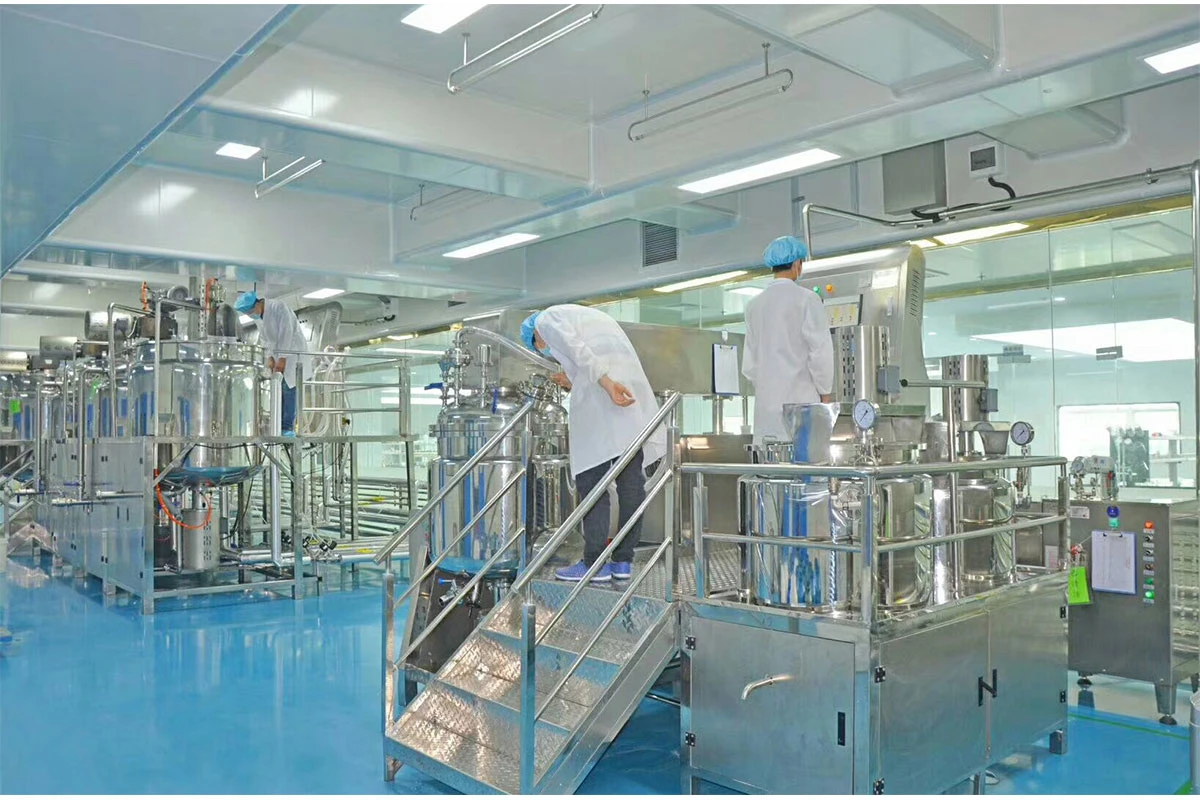
A retinol emulsion is built in the ordinary way up to the cool-down. Oil phase at 75–80°C, emulsify, homogenize, then cool to 40°C before the active goes in. It sounds routine, and it is the step where a private label retinol serum manufacturer either earns the account or loses it six months later in the marketplace. Below 40°C the all-trans form is reasonably stable in a properly chelated system; at 45°C and above you start paying for the isomerization in the first hour. The window sounds generous until you watch a 500 kg batch take 40 minutes to drop the last 8°C.
Then the physical parameters that most brands never see:
Our own starter builds sit in the 0.3% encapsulated retinol formula and the 0.5% retinol plus bakuchiol blend; both were validated in a dropper shell first, then re-run for the airless pump because the fill and headspace change is enough to move the 12-week number by 2–4 points. That re-run is not optional and it is not free.
At 1,000 pcs of 30 ml you are making about 30 liters of bulk, plus 6–8% process loss, so roughly 32–33 liters. That is a small batch, and any private label retinol serum manufacturer quoting off a 500 kg run is quoting a price you will not be offered. Expect the unit price to run 8–12% above that run, and expect wider assay spread between bottles, because a 50-liter vessel has less thermal inertia and the cool-down curve is steeper.
| Build | Active cost per 30 ml | 12-week retention at 40°C | Where it fits |
|---|---|---|---|
| 0.3% free retinol | USD 0.05–0.08 | 78–85% | Cost-driven, 12-month shelf life, airless mandatory |
| 0.3% encapsulated | USD 0.14–0.20 | 92–95% | 24-month shelf life, EU-facing, mass retail |
| 0.5% retinol + 1% bakuchiol | USD 0.18–0.26 | 90–94% | Markets that want “retinol” without the irritation file |
| 1.0% retinaldehyde | USD 0.30–0.42 | 82–88% | Clinic channel, GCC and ASEAN only |
The numbers are active cost, not landed price — the shell, the carton and the fill each cost more than the retinol in the cheap builds. A gold airless pump with a two-color print can add USD 0.28–0.45 per unit, which is why brands that “just want retinol” end up reformulating to a lower dose and a stock bottle instead of paying for encapsulation plus a premium shell.
What you get for the premium is roughly 10 points of retention at 12 weeks and a defensible 24-month date. If you sell at USD 4 retail and turn inventory in 90 days, that trade is bad and you should not make it.
Three situations where I tell buyers to stop.
Under 1,000 pcs. Below that, the batch is lab scale, and no plant will run a 12-week stability program across a formula and packaging combination for free. You pay for it — USD 800–1,500 per formula per shell — and you pay it again every time you change the bottle.
A 1.0% claim aimed at the EU. The 0.3% RE ceiling makes it non-compliant for face leave-on. Reformulate to 0.3% or route the 1.0% build to the Gulf or ASEAN with the local registration done properly.
Retinol as a single hero with no supporting actives. Retinol at 0.3% is a decent, well-tolerated dose, but a formula with no humectant and no barrier lipid reads thin on the skin and buyers return it. The blends in the retinol serum range that actually move are the ones with a glycerin and squalane base underneath.
If your volume is 500 pcs and your budget is USD 3 landed, the honest answer is a 2% HPR build — our low-irritation retinoid — or a peptide line, not a retinol story you cannot substantiate.
The sequence is fixed because the failure modes are. Brief in, formula match from the library, bench sample in 7 days. You test it for two weeks on your own panel. Bulk runs 35 days after sample approval, and at 1,000 pcs it is a single day on the filling line with a changeover of 4–6 hours if the shell differs from the previous run.
Two things get scheduled in parallel rather than sequentially. The 12-week accelerated stability starts the day the bulk is released, which means it finishes after your first shipment leaves. That is the industry reality, not a shortcut: you ship on the strength of the platform data from the same formula family and the physical parameters of your batch, and the confirmatory curve arrives later. If any factory tells you the 12-week data will be in hand before your first order ships, they are either running a different formula or not running the test.
Every batch leaves with a CoA carrying the retinol equivalent by HPLC, a batch record reference, and retention samples held for 24 months. The document set for export — CoA, MSDS, Free Sale Certificate — is covered in our export documentation checklist, and the plant and certificate scope are on the factory page. The 35-day clock and the MOQ ladder are on the OEM service page, and the testing regime behind the numbers is on quality and certifications.
Not automatically. 0.3% of an encapsulated dispersion is often 0.03% retinol equivalent. Always ask for the equivalent figure on the finished bulk, not the dosage of the raw dispersion.
Target market, target retinol equivalent, pack format and volume, and the claim you intend to print. With those four, a private label retinol serum manufacturer with its own line can quote in 48 hours; without the equivalent figure, any quote is a guess.
A dropper works if the bulk sits at 1,800–2,600 mPa·s and you run a 12-week inverted test in that exact shell. Expect 0.8–1.6% adsorption into the PP pipette bulb over 12 weeks, and slightly faster oxidation than an airless pump with a proper purge.
ISO 22716 at the manufacturing site, a CPSR from a qualified safety assessor, and a CPNP notification filed by your EU responsible person. The Free Sale Certificate is issued to the manufacturing legal entity, so confirm the name matches the plant on your CoA.
—
Send us your brief with the target retinol equivalent, the pack and the volume, and we will come back with a formula and a unit price within 48 hours. 1,000 pcs MOQ per SKU, 7-day bench sample, 35-day bulk lead time after approval — send your brief here.
The first question most buyers ask is how to tell a real private label vitamin C serum manufacturer in China from a trading company with a rented office…
A custom serum formulation service is not a document you receive at the end. It is roughly forty locked decisions, and your brief names three of them. You…
A clean beauty serum formulation guide is only worth reading if it prices the removals. Taking a 30 ml brightening serum to a defensible silicone-free, PEG-free, phenoxyethanol-free position…