Serum Packaging Sizes That Fit Retail vs Clinic Channels
Fifteen, thirty, fifty or a hundred milliliters: serum packaging sizes for retail brands are decided by shelf economics, while clinic packs are decided by cost per treatment, and…
Retinol does not fail in the bottle because the formula was wrong. It fails because the package lets oxygen in twice a day for six months. When a brand asks us to settle the airless pump vs dropper retinol serum question, we run an eight-week in-use panel before quoting: in our last three projects a 30 ml glass dropper lost 11.4% of its retinol claim by week eight, while the same bulk in a 30 ml piston airless lost 4.8%. The gap is real, it costs roughly USD 0.35 per unit, and it is not worth paying in every case. This article gives you the numbers we use to decide, so you can pick a package before you commit a mold.
All-trans retinol degrades through two routes that run in parallel: oxidation to retinal and then retinoic acid, and isomerization to 13-cis retinol. Both are driven by oxygen, light above 450 nm and heat. Amber glass cuts the light route; neither package solves the oxygen route by itself.
The dropper’s problem is headspace exchange. A 30 ml bottle filled with 20 g of product holds about 10 ml of air. Every open-close cycle pushes a fraction of that headspace out and pulls room air back in, so oxygen partial pressure inside the bottle goes back to ambient within a few seconds. We measured 14-17% headspace oxygen at week eight in the dropper arm of our panel, against 3-5% in the airless arm, which started at under 2% after nitrogen flushing at fill.
That is why a 0.3% claim and a 12-month shelf life are two different promises. The shelf life number comes from a 12-week accelerated run at 40°C/75% RH in a sealed pack. The claim number is what the consumer actually receives in month five, and only an in-use test tells you that.
Our standard protocol is 12 panelists, two doses a day, eight weeks, product assayed by HPLC at day 0, week 4 and week 8, with color read on a spectrophotometer. Bulk was identical in both arms: 0.3% encapsulated retinol in a gel-cream base, nitrogen blanketed, BHT 0.05% and tocopherol 0.20% as the antioxidant pair.
| Metric at week 8 | 30 ml glass dropper | 30 ml piston airless |
|---|---|---|
| Retinol remaining vs label claim | 88.6% | 95.2% |
| Color shift, ΔE vs day 0 | 4.8 | 1.9 |
| Headspace oxygen | 14-17% | 3-5% |
| Dose repeatability, CV | 6-9% | 2-4% |
| Product left in pack at end of use | 0.8-1.2 ml | 1.8-2.6 ml |
| Closure or pump failure rate | 0.4% (bulb split) | 0.9% (valve weep) |
Two lines in that table matter more than the headline. First, the airless pump leaves 1.8-2.6 ml behind, so a 30 ml pack delivers about 27 ml. If your label says 30 ml, you need to overfill by 3% or you are short-weighting at the end of use, which is a labeling compliance problem, not a marketing one. Second, the airless failure rate is higher, not lower: a valve that weeps at 0.9% is a return, and returns cost more than the retinol you saved.
An airless pump is a mechanical device with an operating window. A piston-type airless needs viscosity above roughly 3,000 mPa·s at the fill temperature; below that the piston chatters, the dose drifts and product weeps past the seal. Our retinol gel-cream platform sits at 18,000-24,000 mPa·s on a Brookfield RV spindle T-D at 10 rpm, which is comfortable. A thin retinol serum at 2,200-2,800 mPa·s is not, and forcing it into a piston airless is how brands end up with a pump that spits.
In practice the airless pump vs dropper retinol serum choice is decided by the base, not by marketing. The workable answer for thin formulas is a bag-in-bottle airless with a low-dose valve, or a dropper. There is a third factor people forget: adsorption. Over 12 weeks at 40°C we see 0.8-1.6% of the retinol bound to the PP wall of an airless body and essentially nothing on glass. It is small, but if you are already running a 95% claim at week eight, that is where your last percent goes.
Encapsulation changes the constraint. Our 0.3% encapsulated retinol starter uses a 15-25 µm cellulose wall, which passes a 1.2 mm valve orifice without shear damage. The 1.0% retinaldehyde high-efficacy platform is a thin emulsion that we will only quote in a dropper or a bag-in-bottle, because retinaldehyde is more reactive than retinol and the thin base cannot carry a piston. If you are comparing packages across a whole private label retinol serum range, expect to end up with two package types, not one.
At 1,000 pcs per SKU, packaging is the second-largest line in the unit price after the active. These are the ranges we quote on stock molds in Q4 2026, ex-works Guangzhou.
| Item | 30 ml dropper set | 30 ml piston airless | 30 ml bag-in-bottle |
|---|---|---|---|
| Component cost per set | USD 0.30-0.52 | USD 0.62-0.95 | USD 1.20-1.75 |
| Filling speed | 60-80 pcs/min | 35-45 pcs/min | 30-40 pcs/min |
| Component lead time | 12-18 days | 22-30 days | 30-40 days |
| Custom mold / tooling | USD 1,200-2,500 | USD 3,500-8,000 | USD 6,000-12,000 |
| Minimum for a custom color | 1,000 pcs | 3,000 pcs | 5,000 pcs |
The component gap looks like USD 0.32-0.43, and the slower fill adds USD 0.04-0.07 of labour. Call it USD 0.35-0.50 per unit, or six to eight points of margin on a USD 6.00 ex-works price. That is the honest price of the four to seven points of retinol you keep.
The constraint nobody puts in a spec sheet is the tooling threshold. At 1,000 pcs we can run a dropper in a custom Pantone color, but an airless pump in the same color needs 3,000 pcs and a USD 3,500-8,000 mold. So the first production run of a new brand usually goes out in a stock airless shell with a printed label, and the custom shell waits for run two. If your launch plan is 1,000 pcs and a bespoke silhouette, the airless pump vs dropper retinol serum decision is already made for you by the mold.
A dropper wins on three concrete cases, and we say so before quoting. First, thin formulas: anything under 3,000 mPa·s, which includes most water-based retinol serums and every retinaldehyde emulsion we make. Second, trial and clinic sizes: 15 ml in a dropper is a standard component, while a 15 ml airless is a custom order at 5,000 pcs. Third, brands that need to show the product: a clear or amber dropper lets the buyer see color and viscosity, which matters in sampling kits and trade shows.
If your answer to the airless pump vs dropper retinol serum question is a dropper, spend the extra USD 0.05 on a nitrile bulb instead of silicone. Silicone permeates oxygen faster, and a nitrile bulb plus nitrogen flushing at fill took our dropper arm from 88.6% to 92.9% at week eight in a follow-up run. It still does not beat the airless, and the advantage decays from the first time the consumer unscrews the cap, so pair it with a six-month period-after-opening statement rather than a twelve-month one.
There is one more tradeoff worth writing into the brief: a dropper invites finger contact with the pipette and the bottle neck. That pushes you toward a full ISO 11930 challenge test with a preserved system at the upper end of the allowed range, where an airless with a sealed dose chamber is a lower microbiological risk from the start.
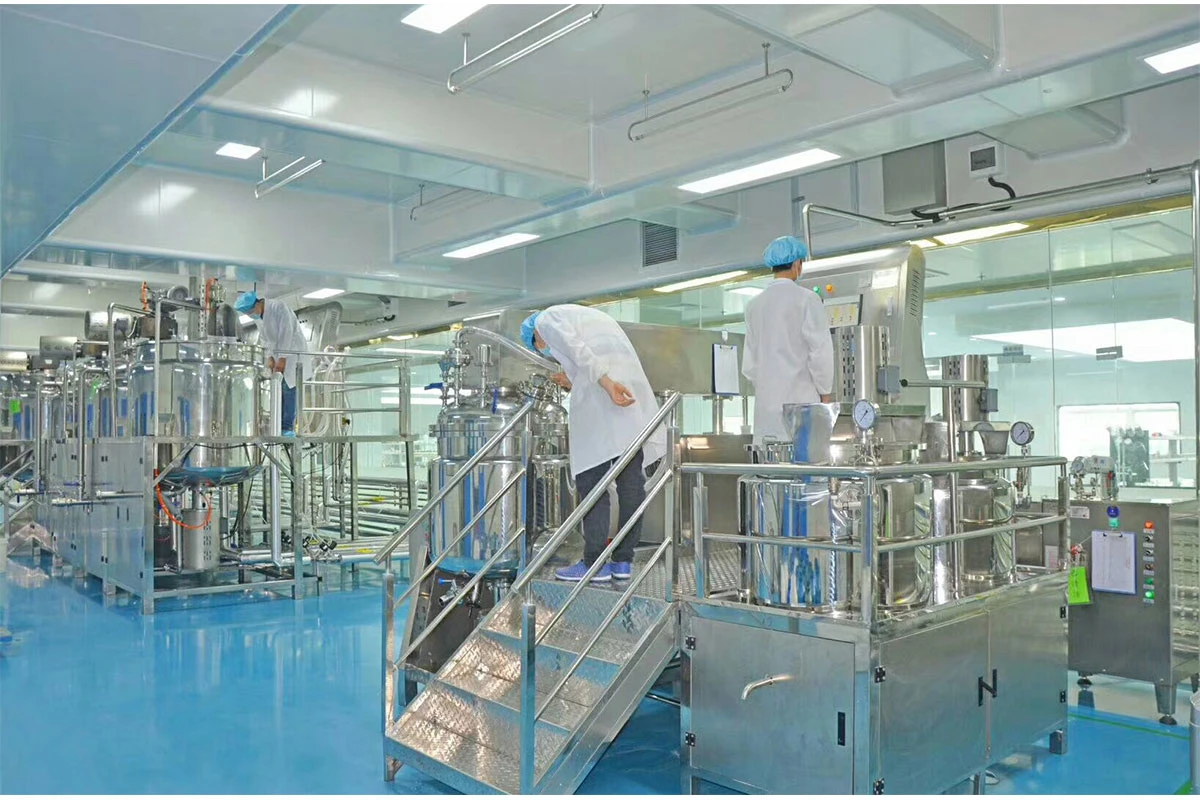
Retinol goes in at cool-down, never above 40°C, and the batch is homogenized at 2,500 rpm for eight minutes before it is de-aerated under vacuum. For an airless fill we pull the piston with -0.6 to -0.8 bar vacuum and dose 30.5 g ± 1%, then run a dose-weight check every 30 pcs with a CV limit of 3%. A dropper line runs faster but needs a nitrogen blanket over the filler bowl and a torque check on the collar, because a collar at the wrong torque is the most common leak we see in transit.
Validation does not change with the package, whichever way the airless pump vs dropper retinol serum decision falls: 12 weeks at 40°C/75% RH, three months at 30°C, plus a freeze-thaw cycle for export routes, all run in the same stability chamber against the sealed retail pack. The in-use data goes into the CPSR, because retinol sits under EU 1223/2009 with the 0.3% RE cap for face leave-on products under Reg (EU) 2024/996, and a CPNP filing against a 0.3% claim needs the week-eight assay, not just the accelerated result. What changes is the compatibility file. For an airless we add a 40°C/10-day migration screen on the valve gasket and the PP body, and a pump cycling test of 300 actuations. You can see the full test list on our quality and testing page, and the component options we keep in stock are listed under serum packaging.
Every batch leaves the ISO 22716 site with a COA and a full INCI declaration, and the GMPC audit covers the filling line, not just bulk manufacture.
One practical note on the line: airless filling is a different set of change parts. A 30 ml piston airless runs 35-45 pcs/min on our line against 60-80 for a dropper, and the changeover is four to six hours, not forty minutes. On a 1,000 pcs order that is a rounding error. On a 50,000 pcs order it is the difference between two shifts and four.
The dropper, by USD 0.35-0.50 per unit at 1,000 pcs. You pay it back in retinol: 11.4% loss versus 4.8% at week eight in our panel, which is the difference between holding a 0.3% claim and quietly shipping 0.27%.
Yes, if the base is above 3,000 mPa·s at fill temperature. Below that, use a bag-in-bottle airless or a dropper. Most 0.5% retinol blends with bakuchiol sit around 8,000-12,000 mPa·s and are fine.
A stock airless adds 22-30 days to component procurement, and a stock dropper 12-18. Our 35-day bulk lead time assumes the component is in stock; a custom airless color adds 15 days for the mold and a 3,000 pcs minimum. If your launch date is fixed, choose the package before you approve the formula.
—
Send us your brief with your target retinol level, fill size and launch volume, and we will come back with two package options, an in-use test plan and a unit price within 48 hours — 1,000 pcs MOQ per SKU, 7-day bench sample, 35-day bulk lead time.
Fifteen, thirty, fifty or a hundred milliliters: serum packaging sizes for retail brands are decided by shelf economics, while clinic packs are decided by cost per treatment, and…
Buyers who raise the ISO 22716 vs GMPC certification question usually want a one-line answer about which logo looks better in a quotation pack. The honest answer is…
Halal and vegan serum certification is two audits sold as one project, and the paperwork is the smaller half. One asks where every gram of raw material came…