Serum Packaging Sizes That Fit Retail vs Clinic Channels
Fifteen, thirty, fifty or a hundred milliliters: serum packaging sizes for retail brands are decided by shelf economics, while clinic packs are decided by cost per treatment, and…
A tranexamic acid niacinamide serum is where most brands land once they accept that hydroquinone is off the table in the EU, and it is one of the few brightening stacks that fits in a plain water gel instead of a two-chamber package. Both actives are water-soluble, both sit comfortably at pH 5.5-6.5, and neither needs encapsulation or a nitrogen headspace. The difficulty is not the chemistry — it is electrolyte tolerance in the thickener, and proving the dose you print on the carton actually exists in the bottle. What follows is the dosing grid we quote, the polymer decision that determines whether the gel still holds viscosity in month 24, and where the unit price really goes at 1,000 pcs.
Hydroquinone is prohibited as a cosmetic ingredient in the EU, so a brand selling into the EU, the UK or most of Southeast Asia cannot build a tone-correction line around it. That single regulatory fact is what pushed this combination into the default slot.
The two actives also hit different steps, which is why the claim survives a formulator’s review. Tranexamic acid interferes with the plasminogen-plasmin pathway that UV exposure upregulates in melanocytes; niacinamide works further downstream by limiting how much melanin is transferred from melanocytes to keratinocytes, and it rebuilds barrier lipids while it is there. Two levers, low overlap, no antagonism — that is a rarity in brightening and the reason this pairing is not just marketing convenience.
The honest caveat: neither lever is as fast as hydroquinone. On a chromameter you will see a measurable change by week 8 in a compliant panel; the consumer sees it closer to week 12. Melasma is also a recurring condition, so the claim you file should be about tone evenness over a course, not eradication.
Most briefs we receive ask for a single number — “can we go to 5%?” — when both actives move together. This is the grid we walk through on the call.
| TXA | Niacinamide | Positioning | What breaks first |
|---|---|---|---|
| 2% | 4% | Entry brightening for sensitive-skin brands | Nothing technically; the claim gets thin, because 2% TXA needs a full 12-week study to separate from placebo |
| 3% | 4-5% | The volume SKU that most commercial tone-correcting serums sit at | The ionic load starts to fight a standard carbomer at the 8% dissolved-solids mark |
| 5% | 4% | Post-inflammatory marks, stubborn tone | Conductivity; the gel thins unless the rheology modifier is chosen for electrolyte tolerance |
| 5% | 10% | Oil control plus tone, acne-adjacent briefs | 10% niacinamide below pH 5.5 converts to nicotinic acid and a minority of users report flushing |
Two rules sit behind the table. First, push TXA before you push niacinamide: TXA is the active with the tone evidence and the lower irritation ceiling, while niacinamide above 5% mostly buys sebum control and a harsher number on the front of the carton. Second, at 5% TXA with 4% niacinamide you are dissolving roughly 9% solids into water — the formulation problem moves from the actives to everything holding them in suspension.
This is the part brands discover after the first pilot batch of a tranexamic acid niacinamide serum. Dissolved TXA and niacinamide form an electrolyte load that most gel thickeners were never designed to carry. A conventional carbomer homopolymer, neutralized with sodium hydroxide or triethanolamine, will lose 30-60% of its yield value within a week of filling once the electrolyte load passes roughly 8%. The batch looked right at release; the first commercial units are visibly thinner.
We run a polyacrylate crosspolymer at 0.8-1.2% as the primary rheology modifier for a 5% TXA / 4% niacinamide brief, because it holds structure in a 7-9% electrolyte environment where the carbomer route does not. Xanthan gum is the cheaper fallback and genuinely electrolyte-tolerant, but it is stringy on the skin, has a low yield value so the gel sags on a warm shelf, and it shears down if the filler runs the pump too hard. Sclerotium gum sits between the two on feel and above both on price.
The specification we hold at release is 9,000-14,000 mPa·s (Brookfield RVT, spindle 5, 20 rpm, 25°C), with a ±15% band across the stability program. Anything above 18,000 mPa·s is a dropper problem, not a quality win — the pipette will not draw cleanly and the fill weight drifts.
pH is where a tranexamic acid niacinamide serum either holds or drifts, and the mechanism is niacinamide hydrolysis. Below pH 5.5 the conversion to nicotinic acid accelerates, and at 40°C over 12 weeks that conversion becomes measurable rather than theoretical. Nicotinic acid is what causes the vasodilation and flushing that a small share of users report from high-dose niacinamide products.
We specify pH 5.7-6.0 at release with a ±0.3 drift allowance, buffered with citrate rather than a strong mineral acid. Tranexamic acid itself is a zwitterionic amino acid and does some of the buffering work on its own, which is a quiet advantage of this pairing over a niacinamide-only gel.
The practical consequence is a hard rule about what cannot share the bottle. A 15% L-ascorbic acid serum needs pH 3.0-3.5 to stay in its useful form; put 5% niacinamide in the same aqueous phase and you get conversion, flushing and a formula that ages badly. If your line needs both actives, sell them as two SKUs on an AM/PM routine, not one hero product.
Tranexamic acid is manufactured at pharmaceutical-intermediate scale, so it is commodity-priced in a way that peptides and encapsulated retinoids are not. That changes the economics of a brightening SKU entirely.
| Line item | Load in a 30 ml fill | Approximate cost per unit |
|---|---|---|
| Tranexamic acid, 99%+ cosmetic grade | 0.9 g at 3% | USD 0.03-0.06 |
| Niacinamide, 99.5% | 1.5 g at 5% | USD 0.01-0.03 |
| Electrolyte-tolerant polyacrylate | 0.3 g at 1.0% | USD 0.02-0.04 |
| Preservative: phenoxyethanol + ethylhexylglycerin | 0.3 g at 1.0% | USD 0.01-0.02 |
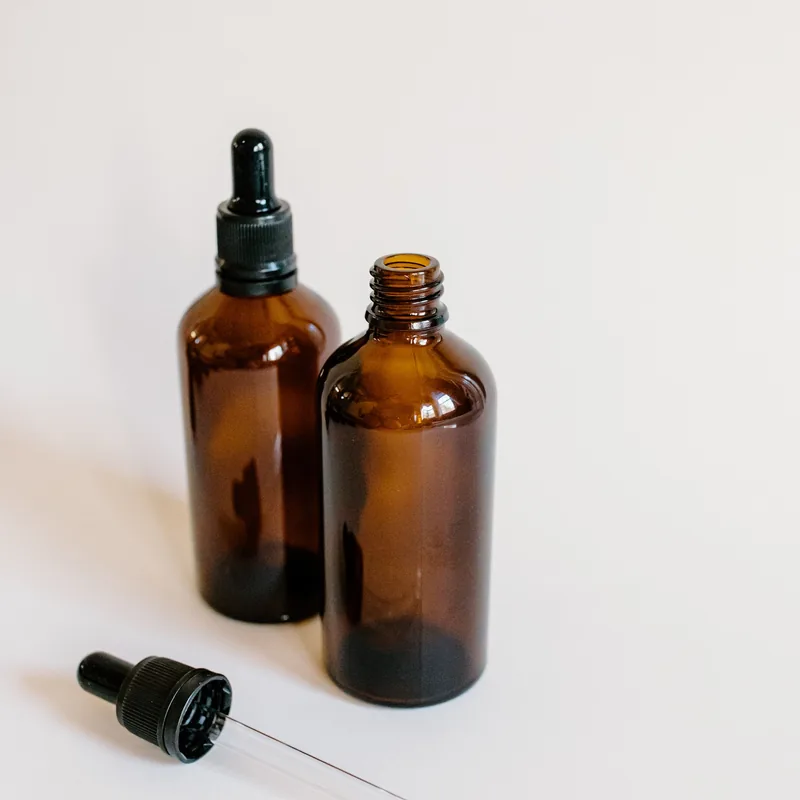
| 30 ml glass dropper, pipette and closure | one set | USD 0.35-0.75 |
| 12-week stability program plus HPLC assay method | fixed per formula | a five-figure one-time cost |
Read the column again: the actives in a tranexamic acid niacinamide serum cost roughly five to ten cents. The packaging costs fifteen times that, and the validation file is where the project budget actually sits. That is the opposite of a peptide serum, and it means the decision to go 3% or 5% TXA is a claim decision rather than a budget decision — a 2% uplift on TXA adds about two cents a unit.
A tranexamic acid niacinamide serum is a strong default for a brightening line, but it is not universal. These are the briefs where we tell a brand to pick something else.
The assay method is the part of this project that most suppliers do not want to discuss. Niacinamide reads cleanly by HPLC with UV detection at 260 nm. Tranexamic acid has no usable chromophore, so a straight UV method at 210 nm sits right on the solvent cut-off and produces numbers that drift with the mobile phase. We run TXA by pre-column derivatisation followed by HPLC, or by LC-MS/MS. If a supplier’s COA shows a TXA result with no method named, the figure is decoration.
Two starting points cover most briefs in this cluster: a 5% TXA + 4% niacinamide tone corrector for a correction-positioned hero, and a 2% TXA + alpha arbutin gentle formula for sensitive-skin and pregnancy-safe positioning. If the buyer wants kojic acid in the mix, a 3% TXA + kojic brightening platform exists, and brands that lead with the niacinamide story instead usually start from a 5% niacinamide + 2% TXA tone formula. The full ingredient-level view sits on our tranexamic acid serum platform, and the certificate set we issue is spelled out on the quality page.
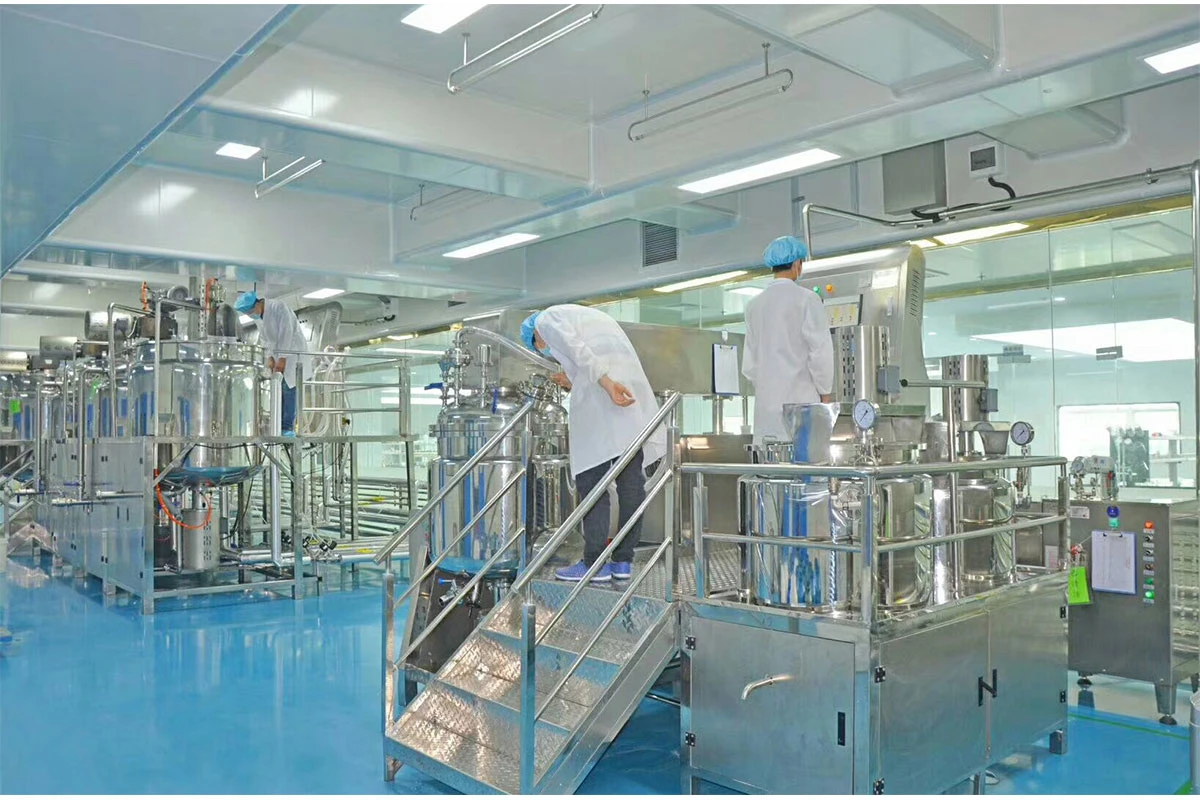
Process-wise this is a cold batch: water and glycerin at 25-35°C, TXA dissolved first because it goes into solution quickly, then niacinamide, then the polymer dispersion, then pH adjustment to 5.7-6.0, then preservative. No high-shear homogeniser — at 9,000 mPa·s a rotor-stator only entrains air, so we use a low-shear anchor agitator and vacuum deaerate before filling. Filling runs in an ISO 8 cleanroom under ISO 22716 and GMPC, with an in-line fill weight check at ±1%.
Every tranexamic acid niacinamide serum we scale up is assayed at release, 24 hours, 4 weeks and 12 weeks, against a specification of 90-110% of label for both actives. We also run 40°C/75% RH and 25°C/60% RH chambers, three freeze-thaw cycles, and a photostability run inside the actual primary packaging — the dropper you choose is part of the study, not an afterthought. Because neither active is oxygen-sensitive, a 30 ml glass dropper is fine here and saves the airless premium of roughly USD 0.45-0.80 per unit at 1,000 pcs. Add a retinoid or a vitamin C derivative to the same SKU and that flips to airless immediately.
Documentation is a batch COA carrying both assays, an MSDS, full INCI and a Certificate of Free Sale. CPNP notification for the EU and SCPN for the UK are the brand’s filings; we supply the safety data and the ingredient documentation they need. An ISO 11930 challenge test is run on every preservative system, because a 9% solids water gel is a growth medium, not a hostile one.
No, not with L-ascorbic acid. It needs pH 3.0-3.5 and niacinamide at that pH converts to nicotinic acid. Either sell them as an AM/PM pair, or switch the vitamin C to a non-acidic derivative and accept a weaker efficacy claim.
An instrumented panel separates 3% from placebo by week 8. Consumer perception lands closer to week 12. Below 3% you are adding a supporting act for the ingredient list, and the claim should be written that way.
Yes, and you should ask which method produced it. Without derivatisation or mass detection the value is unreliable, which is precisely how brands end up selling a 5% product that assays at 3.4%.
A 30 ml glass dropper is the default, because nothing in this formula is oxygen-sensitive and the airless premium buys you nothing. Move to airless only if you add an oxidation-prone active alongside the brightening pair.
—
Send us your brief with the target market, the claim you need to file and the container you already have in mind, and we will come back within 48 hours with a formula sheet, a use level for both actives and a unit price — including a straight answer on whether your tranexamic acid niacinamide serum should sit at 3% TXA or 5%. Samples run 7 days, MOQ is 1,000 pcs per SKU, and bulk lead time is 35 days.
Fifteen, thirty, fifty or a hundred milliliters: serum packaging sizes for retail brands are decided by shelf economics, while clinic packs are decided by cost per treatment, and…
Retinol does not fail in the bottle because the formula was wrong. It fails because the package lets oxygen in twice a day for six months. When a…
Buyers who raise the ISO 22716 vs GMPC certification question usually want a one-line answer about which logo looks better in a quotation pack. The honest answer is…