Packaging decisions are usually made from mood boards. They should be made from the formula’s failure modes. A vitamin C serum in a clear dropper bottle is not a branding choice — it is a decision to ship a product that will discolor before it sells.
Dropper bottles
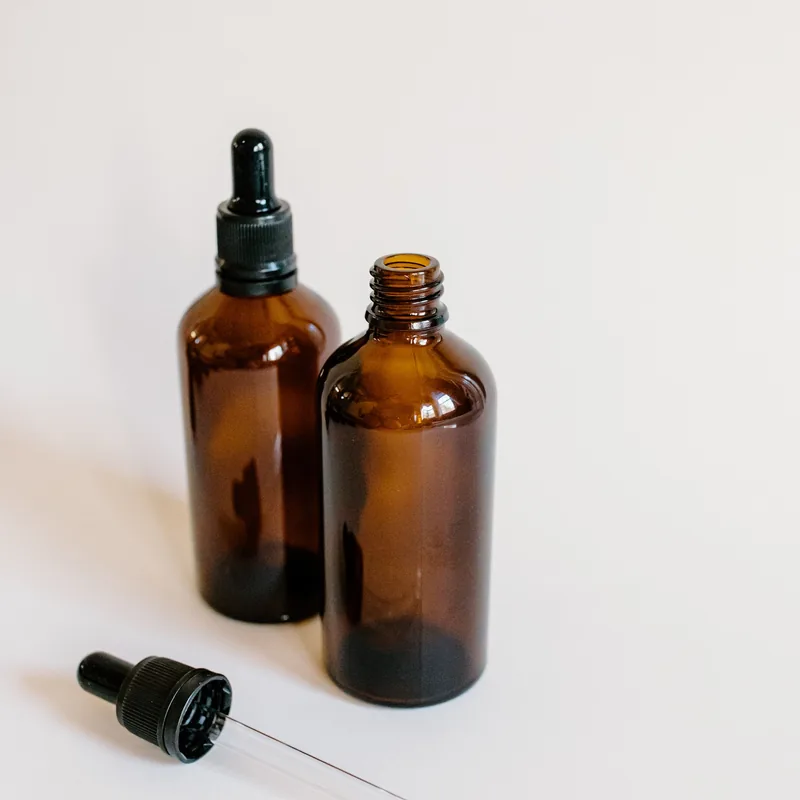
The default for a reason: cheap, familiar, works with low-viscosity serums, and the ritual of the pipette reads as “clinical” to customers.
Where they fail:
- Oxygen exchange. Every use pulls air in. For oxidation-sensitive actives, this is the dominant failure mode.
- Dose inconsistency. A pipette delivers a variable volume depending on how far the bulb is squeezed. Fine for a serum, unacceptable for anything with a stated dose.
- Viscosity ceiling. Above roughly 3,000–5,000 cP, a standard pipette struggles to draw product up, and the last third of the bottle becomes unusable.
Best for: niacinamide, hyaluronic acid, peptide and most tranexamic acid formulas — anything not critically oxygen-sensitive.
Airless pumps
A vacuum-driven piston rises as product is dispensed, so the formula never contacts air until it leaves the nozzle. Oxidation exposure drops dramatically compared with a dropper.
Where they fail:
- Cost. Typically two to four times the unit cost of a dropper assembly.
- Priming. Airless pumps need several strokes on first use. Some fill lines struggle to fully evacuate air from the chamber, which customers experience as a “half-empty” bottle.
- Residual waste. A poorly matched piston leaves 3–8% of product in the bottle. On a premium formula that matters.
- Minimums. Airless components usually carry higher MOQs than standard droppers.
Best for: L-ascorbic acid, retinaldehyde, and any formula where oxidation is the primary stability risk.
Ampoules
Single-dose glass ampoules give the best protection available — sealed, no preservative load needed in some cases, and a strong premium signal.
Where they fail:
- Filling complexity. Ampoule lines are slower and the sealing step needs tight control. Expect higher unit cost and longer lead time.
- Customer friction. Opening glass ampoules is a barrier for some markets, and there are breakage and safety considerations in transit.
- Glass particles. A poorly controlled snap-off can introduce glass fragments. This needs a validated sealing process, not just the right machine.
Best for: high-value actives where dose accuracy and freshness justify the cost — copper peptides, high-strength retinaldehyde, prescription-adjacent products.
Three compatibility checks people skip
1. Does the formula attack the closure?
High-glycol and anhydrous formulas are aggressive toward certain rubbers and plastics. A dropper bulb that swells or a pump gasket that degrades will show up in month six, not in week one. Ask for compatibility data on the specific closure, not the bottle.
2. Does the viscosity match the dispensing mechanism?
Filling tolerance and pump output both depend on viscosity, and viscosity is temperature-dependent. A serum that fills perfectly at 25 °C can behave very differently at 40 °C in a summer warehouse.
3. Does the bottle survive the drop test?
Glass droppers in e-commerce packaging fail more often than brands expect. If your channel is direct-to-consumer shipping, test the finished pack — not just the formula.
Rule of thumb: choose packaging after the formula’s stability profile is known, not before. If your supplier lets you pick the bottle first and formulate second, they are optimising for a quick sale.